
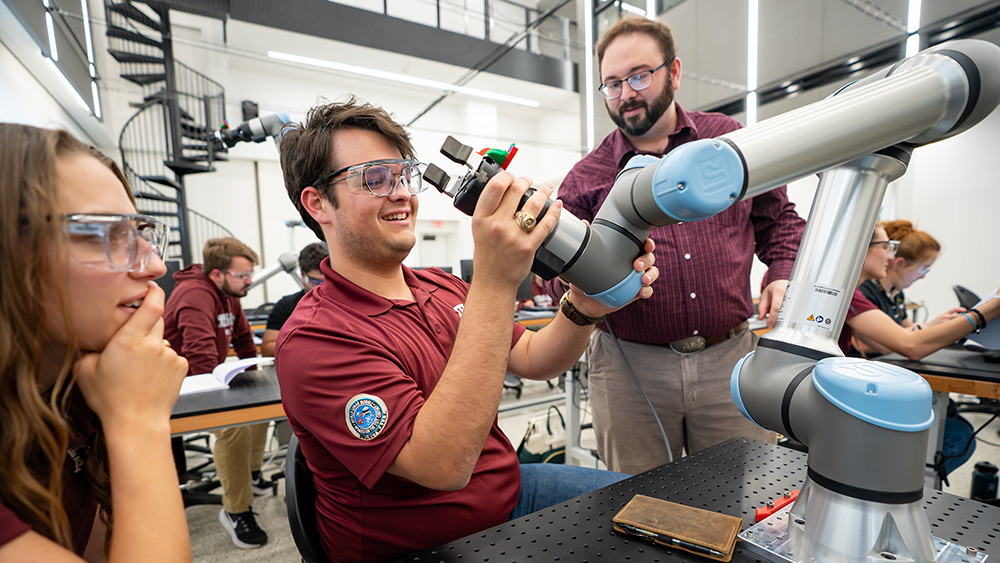
AggiE-Challenge gives engineering students the chance to join multidisciplinary teams, work on faculty-led research and solve real-world problems, all while earning course credit and building technical and professional skills.
Student FAQs
- How do I choose a project?
- Browse current projects and identify those that align with your interests, major, and classification. Each project is assigned a dedicated ENGR 291/491 section.
- How do I enroll?
- Register for the appropriate ENGR 291/ 491 section in Howdy during open registration.
- Do I need prior research experience?
- No. Most projects are designed to provide students with hands-on research experience while working alongside faculty mentors and multidisciplinary student teams. Specific skills or prerequisites, if required, will be listed in the project description.
- Can I participate if the project is outside my major?
- Yes. AggiE-Challenge is built around multidisciplinary collaboration. Many projects welcome students from multiple engineering disciplines, and some are open to all majors. Be sure to review the eligibility requirements for each project.
- Does it count toward my degree?
- We encourage students to discuss it with their academic advisor. While AggiE-Challenge courses may not satisfy degree requirements for all majors, they provide valuable opportunities to develop technical, professional, teamwork, and research skills that complement your academic program and enhance your career readiness.
What are the benefits of participating?
- Hands-on research experience
- Direct interaction with faculty mentors
- Experience working in multidisciplinary teams
- Exposure to real-world engineering challenges
- Professional and technical skill development
- Course credit while contributing to impactful projects
Course Descriptions
Course information is subject to change. For the most current information, please visit the course catalog or the Aggie Schedule Builder.
Advanced Vapor Compression Desalination
Faculty: Dr. Mark Holtzapple
Open to ALL Majors
Advanced vapor compression desalination has the efficiency of reverse osmosis and the robustness of multi-stage flash. In the future, advanced vapor compression desalination has the potential to become the dominant method for desalinating seawater. Minerals can be captured from the waste brine, which greatly improves economics and also reduces environmental impact.
Disaster Informatics Solutions: Integrating Human and Machine Intelligence for Resilient Infrastructure and Smart Emergency Relief
Faculty: Dr. Ali Mostafavi
Open to CSCE, CVEN, ECEN, and ISEN majors
The students in this project will create intelligent systems to harness community-scale big data (such as population movements, social media activities) and leverage data science and machine learning technologies to help communities better prepare and respond to natural disasters.
Experimental Vibration Analysis of Architected Structures
Faculty: Dr. Dimitris Lagoudas and Dr. Rawad Yazbeck
Open to AERO, CVEN, and MEEN majors
Vibrations play an important role in the performance of structures ranging from aircraft and vehicles to buildings and mechanical systems. In this project, students will learn how engineers experimentally measure and understand structural vibrations. Students will first conduct vibration experiments on canonical systems to explore concepts such as natural frequencies, mode shapes, resonance, and frequency response. They will then apply these techniques to design, build, and test their own architected structure with unique dynamic properties. The goal will be to create structures that can control how vibrations and waves travel through them, including features such as band gaps that block vibrations over selected frequency ranges. Through hands-on experiments and design, students will connect fundamental vibration concepts with the exciting possibilities offered by modern architected materials and structures.
Innovation in Carbon Fiber: Advanced Materials for Next-Generation Structural Solutions
Faculty: Dr. Mohammad Naraghi
Open to AERO, CHEN, MEEN, and MSEN majors
Carbon fibers are considered industry’s best for developing lightweight and strong vehicles. The industry and academia were filled with awe and joy when Boeing 787 Dreamliner was introduced in 2009 with nearly 50% carbon fiber composites used to reduce weight, improve efficiency and safety. This challenge advances experimental methods to make stronger carbon fibers through high-temperature pyrolysis of polymer fibers. By analyzing how processing affects strength and defects, students will develop ways to improve fiber quality. Students will gain hands-on experience making and testing fibers, and develop key soft skills such as teamwork, planning, and communication under the guidance of Dr. Naraghi and his graduate team.
Remote Monitoring and Self-management of Mental Health and Chronic Disease
Faculty: Dr. Farzan Sasangohar
Open to ALL Majors
This challenge focuses on the development, implementation, and evaluation of remote monitoring and self-management solutions for mental health and chronic diseases. Students will gain hands-on experience with digital health technologies, including wearable sensors, mobile health apps, and AI-driven decision support tools. The course emphasizes user-centered design, data collection, and real-world application through case studies and collaborative projects. Participants will also address critical issues such as patient engagement, behavior change strategies, data privacy, and ethical considerations.
Rocket Science Is "Not Rocket Science"
Faculty: Dr. Adonis Karpetis
Open to ALL Majors
The private space industry is leading the "explosive" growth of aerospace engineering everywhere in the nation and certainly in the state of Texas. The basics of rocket science and engineering will be explored during this Aggie Challenge project with emphasis on the "Maker" mentality of amateur rocketry clubs. Solid, liquid, and hybrid propellant rockets will be discussed with an eye to actual construction and implementation of simplified systems. Projects involve thermodynamics, chemical equilibrium, aerodynamics, dynamics, and controls of rockets and apply to a wide variety of systems: from the miniature solid propellant rockets used in elementary amateur devices all the way to hybrids and liquid propellant systems relevant to Base 11 and IREC competitions targeting 30-330-kft altitude launches.
Self-Driving Electrochemical Laboratory
Faculty: Dr. Jodie Lutkenhaus
Open to ALL majors
To accelerate the selection of electrodes and electrolytes for batteries, this project will focus on the construction of a self-driving electrochemical laboratory. Students will collaborate to build, program, and test the laboratory. Early stages of the project will involve procuring components and building them into the laboratory, followed by programming and interfacing with the lab with an electrochemical potentiostat. Later stages will involve testing the electrochemical laboratory and improving its testing rate.
Spacecraft VR
Faculty: Dr. Greg Chamitoff
Open to ALL Majors
SpaceCRAFT VR is a multidisciplinary platform for design and analysis of space systems and entire mission architecture concepts with human-in the-loop operations in virtual reality. SpaceCRAFT provides high fidelity environmental models and the means to integrate systems and algorithms for spaceflight vehicles, habitats, robots, rovers, satellites and any other mission component into a multi-user real-time simulation. It is used for engineering design, astronaut training, human interface testing, and the development of operational concepts for spaceflight missions. It is also used for STEM programs to teach students about space exploration through team-based design challenges. Students working on SpaceCRAFT choose from a wide range of research topics ranging from orbital mechanics to guidance systems, robotics, CAD modeling and animation, network coding and backend development, mechanical systems, planetary science, space physics, and many other topics.
Early Industry Engagement
Sponsors connect with freshmen through senior students and faculty, gaining insight into cutting-edge research and building relationships with future engineers and researchers.
Interested in sponsoring? Contact us at inp@tamu.edu