
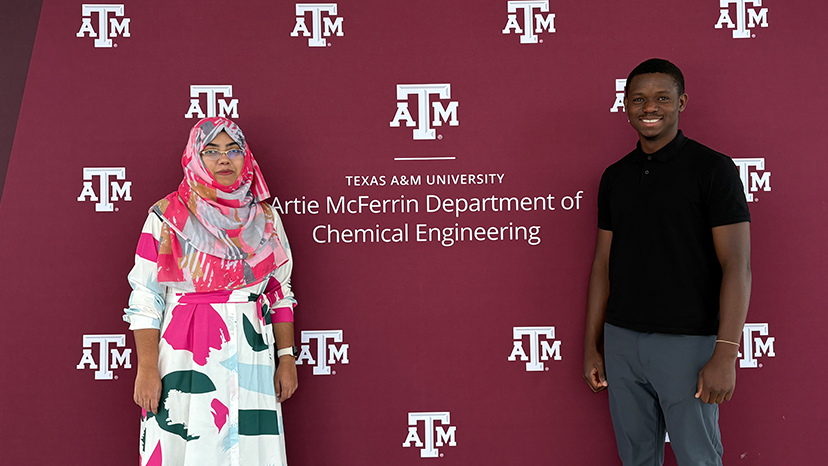
Ph.D. candidates Fatima Mahnaz and Somtochukwu Lambert received the Richard J. Kokes Travel Award, enabling them to attend the 29th North American Meeting of the Catalysis Society (NAM29).
The society sponsors the award to encourage students and provide them with an opportunity to connect with industry leaders.
“It is great to see our top students in the field of catalysis recognized with Kokes Awards,” said Dr. Mark Barteau, chemical engineering professor and Lambert’s faculty advisor. “This program provides important opportunities, not just to interact with leaders in the field, but to build a peer network of future leaders. Fellow Kokes awardees that I connected with more than 40 years ago have remained colleagues and collaborators to this day.”
At the meeting, Mahnaz delivered both a talk and a poster presentation of her work. She also learned about several advanced topics and characterization techniques that relate directly to her current research.
Watching experienced speakers gave Mahnaz ideas for communicating her research more clearly and confidently, she said.
Mahnaz's research focuses on converting carbon dioxide into sustainable fuels and chemicals using bifunctional catalysts that pair metal oxides and zeolites. This method transforms carbon dioxide into hydrocarbons like gasoline or aromatics through a methanol intermediate. She has a particular interest in producing sustainable aviation fuels.
“A key part of my research is understanding how the spatial arrangement between these two catalyst components affects the reaction,” Mahnaz said. “Specifically, I investigate how the reaction mechanism and product yields could be modulated with proximity between metal oxides and zeolite active sites and how reaction and transport fundamentals could be utilized to understand these effects.”
Mahnaz said the vision laid out by the meeting’s plenary speakers was inspiring and a highlight of the experience.
It is great to see our top students in the field of catalysis recognized with Kokes Awards. This program provides important opportunities, not just to interact with leaders in the field, but to build a peer network of future leaders.
“NAM29 stands out as one of the best conferences on catalysis and reaction engineering I have attended to date,” Mahnaz said. “It provided me with valuable opportunities to connect with graduate students, industry professionals, national lab researchers, and professors working in the field.”
Reading papers is one thing, but Lambert said engaging the authors in person was invaluable.
“Many of the sessions I attended focused on the electrification of chemical manufacturing, which aligns closely with my research. Those interactions gave me a lot of motivation and insight.”
Lambert presented his research on radio frequency heating for catalytic dehydrogenation, a project that explores how electrified heating technology can reduce greenhouse gas emissions, enhance reactor performance and potentially lower capital costs in chemical manufacturing.
“So far, our focus has been on propane dehydrogenation, an important reaction for the production of propylene, a key petrochemical building block,” Lambert said.
Looking ahead, Lambert plans to expand the radio frequency heating approach to other industrial chemical reactions.
Along with thinking about the future of his research, Lambert is also considering the impact of this conference on his career development.
“Networking with other researchers and industry professionals in the field helped me think more clearly about my career path and future opportunities,” he said.
Mahnaz agrees and believes this conference had a profound impact on her prospects, saying it provided valuable opportunities to connect with leading researchers as she pursues a career in academia.
“Top researchers in the field have received this award. This is a testament to the students’ quality and the quality of their projects. I wish them well going ahead in their research careers,” said Dr. Manish Shetty, chemical engineering professor and Mahnaz’s faculty advisor.