
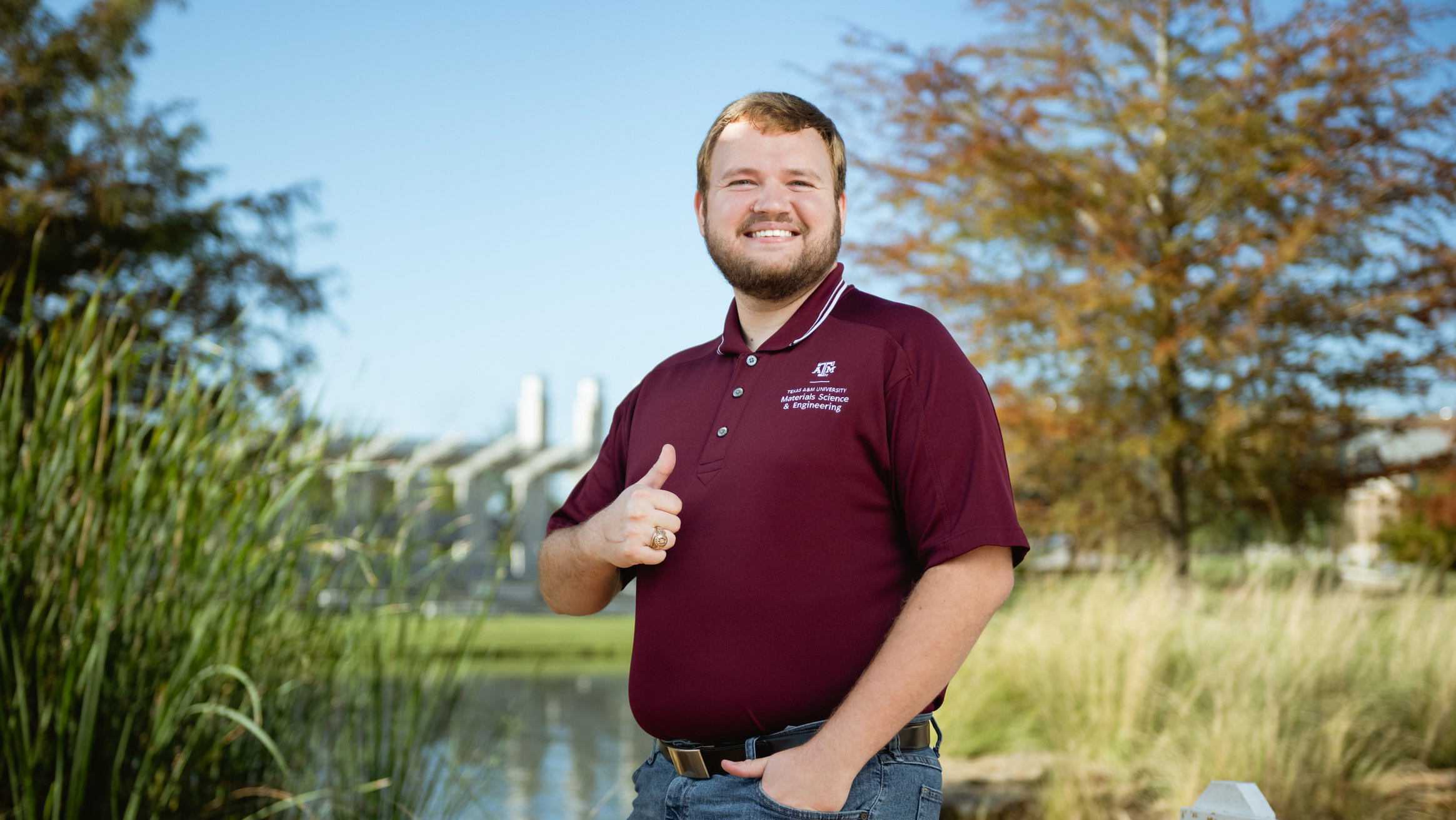
Doctoral student Marcus Hansen’s path to Texas A&M University’s Department of Materials Science and Engineering was anything but traditional, but it has been nothing short of inspiring.
After graduating from high school, Hansen began his studies at the University of Texas at San Antonio. Two years later, he stepped away from school to enter the workforce. That five-year pause ultimately became the spark that ignited his passion for engineering.
While earning his associate degree at Austin Community College, Hansen gained hands-on experience working for Stratasys, a leading 3D-printing company. That experience solidified his decision to transfer to Texas A&M, where he completed his bachelor’s degree in materials science and engineering in May 2024 and immediately began the doctoral program.
A passion for discovery
Hansen’s interest in research began in MSEN 301. After joining the lab of Dr. Kelvin Xie, associate professor of materials science and engineering, he discovered a love for “solving problems that no one’s ever solved before.”
His research focuses on small-scale metal additive manufacturing, polishing samples, imaging grain structures, and testing how feature size influences performance. Early findings show that the tiniest printed lattices can be up to five times stronger than larger ones, suggesting the possibility of creating lightweight, high-strength geometries for aerospace and automotive applications.
“Marcus brings curiosity and determination to exploring the smallest features laser powder bed fusion can produce,” Xie said. “He not only reached the physical limit of the process but also revealed that these tiny lattices outperform their larger counterparts. The SMART Scholarship will support and accelerate his ability to probe these frontiers and position him to shape the future of lightweight, high-strength manufacturing.”
Earning the SMART Scholarship
This spring, Hansen was awarded the Department of Defense’s highly competitive Science, Mathematics and Research for Transformation (SMART) Scholarship. His annual internship will take place at the Naval Surface Warfare Center, Corona Division — Fallbrook Detachment, located between Los Angeles and San Diego.
“The draw for me was the chance to work with advanced technology and to test whether federal research is the right long-term fit,” Hansen said.
He first learned about the SMART Scholarship through departmental emails and even a sidewalk yard sign outside the Zachry Engineering Education Complex. The rigorous application process required multiple steps, including a two-page statement connecting his academic interests to the DOD mission.
He believes he is only the second Aggie in materials science and engineering to receive the scholarship, following Ph.D. student John Broucek. While Texas A&M students across several engineering disciplines have earned the award, recognition within materials science and engineering remains rare.
The SMART Scholarship provides full tuition, a monthly stipend, health insurance and the annual 8 to 12 weeks DOD internship. In return, recipients commit to working for the DOD after graduation. With a high program completion rate, the scholarship creates a strong career pipeline, and many scholars remain in federal service well beyond their required term.
Hansen hopes to continue advancing additive manufacturing technologies, whether in industry or through long-term service with the DOD.
“I want to help build lighter, stronger structures that can make a real impact,” he said. “My path wasn’t straightforward, but it proves that where you start doesn’t define where you can finish.”