
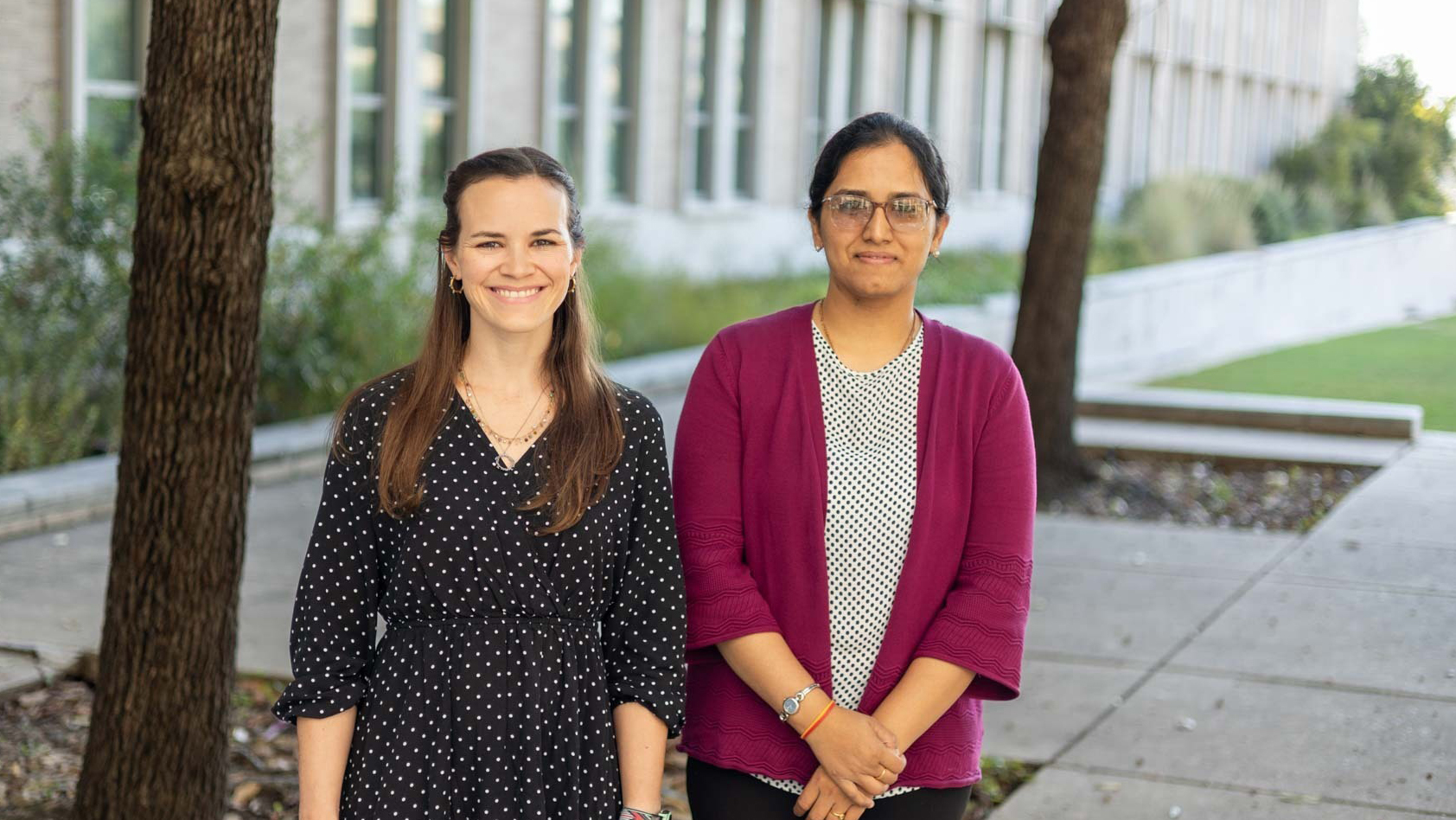
This fall, Dr. Jyothi Menon and Dr. Mary Beth Monroe joined the Texas A&M University Department of Biomedical Engineering, opening two new research labs.
Menon's work explores the use of microscopic nanoparticles to treat cancer as well as organ inflammation and scarring, particularly alcohol-related liver disease. Monroe's lab is devoted to wound healing and infection prevention across a broad scale of injury types, from gunshots to the internal wounds caused by Crohn's disease. The additions expand the department’s focus on cancer treatment and regenerative medicine, as well as the opportunity for collaboration across biomedical engineering fields.
“I am excited about seeing their work move towards real patient impact, which they are both committed to pursuing,” said Dr. Mike McShane, biomedical engineering department head. “We are well-prepared to help them in that journey.”
The most significant contribution Menon and Monroe bring to the department is the potential for collaboration across the diverse fields of biomedical engineering.
“I believe that Dr. Menon and Dr. Monroe’s projects will be strengthened by input and collaboration with colleagues that have additional complementary expertise, and I am intrigued by the possibilities of them working with colleagues in areas that are not obvious from their ongoing projects,” McShane said. “Seeing the unexpected, creative ideas that come from conversations between colleagues that have very different backgrounds is one of the coolest experiences of my career.
“It is even more rewarding when those initially ‘wild’ ideas lead them to pursue potentially impactful projects, patent them, co-mentor students, gain external support for their interesting projects and publish their results to a wide audience.”
A closer look at the Menon lab
Menon brings her work to Texas A&M after 8 years at the University of Rhode Island.
"There's a lot of synergy in terms of my research and the research that's going on in the Texas A&M biomedical engineering department," Menon said. "Biomedical research is increasingly a very collaborative venture; you can no longer work in your lab alone and generate a product that can get into the clinic or to the market to treat different conditions. Here in particular, there's a lot of very interesting tissue engineering and regenerative medicine research happening. That was very attractive to me."
Menon's research focuses on designing nanoparticles 1,000 times smaller than the diameter of a human hair to treat lung and liver diseases.
"We are able to embed different therapies within the matrix of the particle," Menon said. "Depending on how the particle breaks down, the drug gets released over a few hours, a few days or even a few weeks, depending on the material that we use."
If you are trying to target a cancer cell, the cancer cell expresses certain proteins or markers that are not seen in the same amount on a healthy cell or a healthy tissue. By using nanoparticles that bind to that protein or that marker, you can get more of these particles to go specifically to the cancer cell and less to healthy cells and healthy tissues.
By altering the surface structure of nanoparticles, Menon's team can design them to interact only with specific cells within an organ. This approach allows for more targeted treatments than traditional therapies.
"If you are trying to target a cancer cell, the cancer cell expresses certain proteins or markers that are not seen in the same amount on a healthy cell or a healthy tissue,” Menon said. “By using nanoparticles that bind to that protein or that marker, you can get more of these particles to go specifically to the cancer cell and less to healthy cells and healthy tissues. In this way, we can reduce toxic effects from the drug getting released in the wrong location."
The nanoparticles are made from widely available polymers and lipids, and their surfaces can be augmented with antibodies or certain small proteins. Menon's current research incorporates a semisynthetic bile acid that binds to specific liver cells affected by alcohol-related liver disease.
Next semester, she will bring her expertise into classrooms, teaching Aggie biomedical engineering students about drug delivery from an engineering perspective.
"I'm really excited to contribute to the department and get started with my research," Menon said. "I'm teaching next semester, and I'm really looking forward to it."
A closer look at the Monroe lab
After being a faculty member at Syracuse University in New York for seven years, Monroe is eager to bring her expertise back home. Both she and her husband are Aggies and native Texans, with family throughout the state.
"There's so much happening, there's so much energy, so much growth, so many people doing so many cool things," Monroe said. "I think A&M has a really good infrastructure for innovation and commercialization."
In her lab in the Emerging Technologies Building, Monroe develops new materials to improve wound healing, creating solutions that range from bandages to wound-filling foams.
"My research is focused on making biomaterials to help address a range of wound healing applications, from stopping bleeding in traumatic wounds to preventing infections and even designing materials that actually drive forward the healing process," Monroe said. "Basically, the full spectrum of healing from initial injury and stabilizing the patient to seeing that the wound is fully healed."
Monroe's research uses biomaterials ranging from water-absorbing hydrogels to shape-changing polymers, each tailored for a specific type of wound treatment.
My research is focused on making biomaterials to help address a range of wound healing applications, from stopping bleeding in traumatic wounds to preventing infections and even designing materials that actually drive forward the healing process.
"We use a lot of materials called shape memory polymers, which are smart materials that you can synthesize in a primary shape, and then you program them in some way into a secondary temporary shape. They stay in that secondary shape until you apply some other type of stimulus, such as heat," Monroe said. "A lot of what we do with these shape memory polymers is make foams for large injuries like explosive blasts or gunshot wounds. These foams are kind of like a sponge, but you can squish them down to be really small. That lets you put them into the wound. Then, once they're heated up to body temperature, they go back to their primary shape and expand to fill up the wound and stop the bleeding."
Body temperature is only one trigger for shape memory polymers. Others can be programmed to react to bacteria, light or even magnetic fields. This versatility enables treatments for a wide range of wound types.
"One of my favorite projects that we're working on is a shape memory polymer that changes shape in the presence of bacteria," she said. "If there's no bacteria there, you put the dressing on the wound and it's just a static cover like a bandage. If there are bacteria in the wound, they induce a shape change and the dressing shrinks. First of all, that lets you see externally that an infection has started. But the other cool part of this is that that shape change actually prevents bacteria from sticking to the material, and if there's bacteria underneath it, it can dislodge them and make them easier to kill. If you come in and put in an antimicrobial or even an antibiotic, you can kill those bacteria much more easily than you could before when they were in their protective matrix."
Shape-changing bandages could play a crucial role in fighting antibiotic resistant bacteria, and Monroe’s collaborations with fellow Texas A&M researchers will enhance their effectiveness. Future designs may incorporate plant-based antimicrobials, such as phenolic acids, that would allow bandages to fight infection with a reduced risk of creating drug-resistant strains or molecules that change color as they change shape. The bandage of the future may come from Monroe's lab.
"The biomedical engineering department's emphasis on commercialization and getting translational research out the door — out of the lab and into the clinic — is something that's important to me as a biomedical engineer,” she said, “I don't want to just do stuff that's cool in the lab. I want to do stuff that actually makes a clinical impact."