

In the electrical and computer engineering department, AI is not a standalone technology or a single course sequence. We’ve designed it to be a horizontal capability that connects theory, hardware, software, systems, and deployment.
Our department is building an AI ecosystem for ECE: a coordinated set of learning pathways, research opportunities, seminars, industry upskilling, and Capstone experiences designed to ensure AI fluency at multiple levels for every student.
AI Ecosystem at TAMU
Our AI/ML ecosystem integrates coursework, hands-on learning, research and industry-relevant experiences throughout the student journey as follows:
- Foundation: Required sophomore AI course establishes shared language, core models, and responsible practice.
- Integration: AI is embedded across ECE subareas, not one-size-fits-all.
- Practice & Impact: Short sprint courses, research pathways, and AI capstone projects translate fluency into real outcomes.
The AI Ecosystem is supported by the AI Makerspace, research pathways and short courses, and is built on:
- Core Competencies
- Sophomore AI Foundation (Required)
- AI Across ECE Courses
- Capstone: Real-World AI
- Graduate Research Portfolio
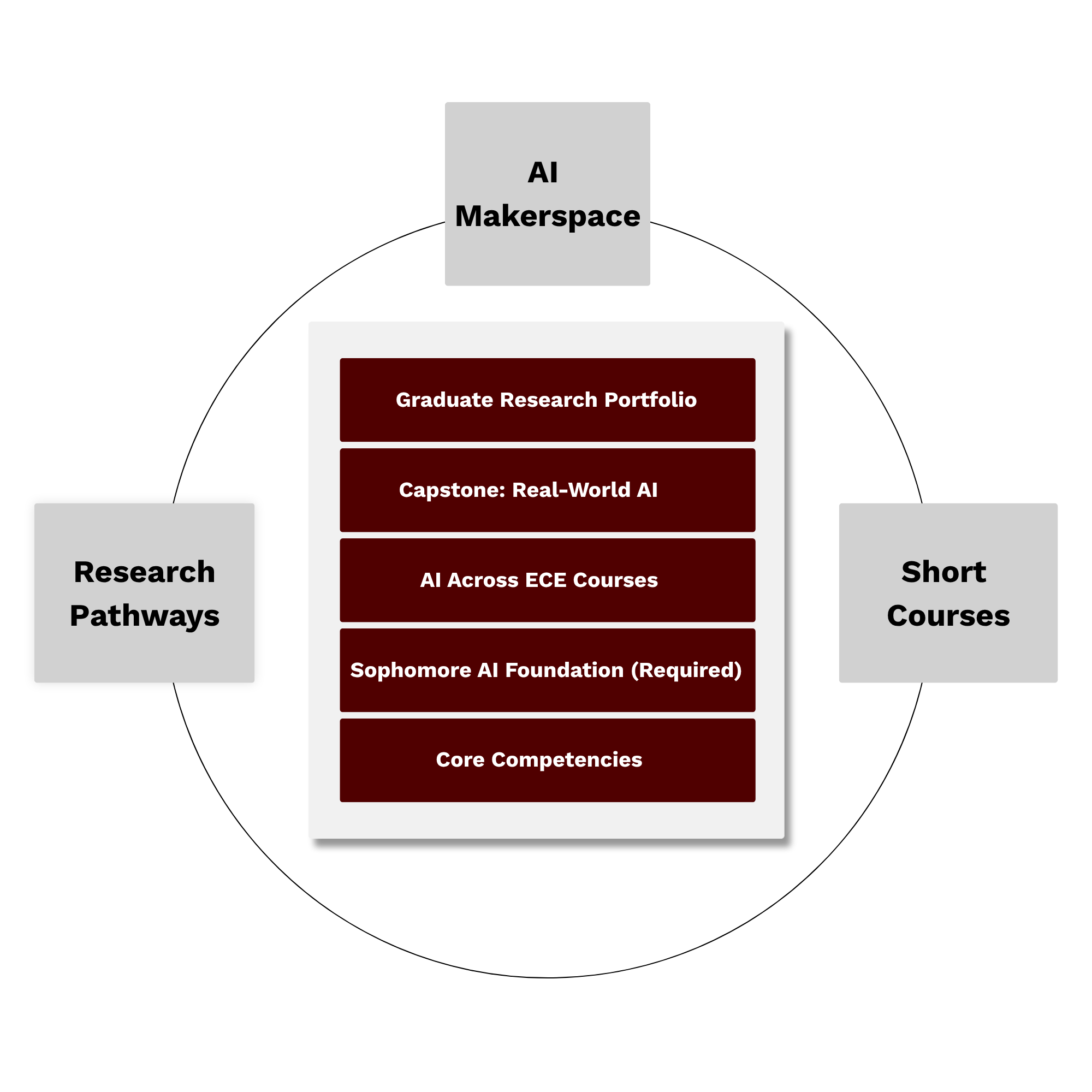
What the Ecosystem Enables
- AI fluency for every student, from fundamentals to application and deployment.
- AI across the stack with methods grounded in ECE context (data, signals, physics, systems).
- Research immersion for junior research scholars, lab opportunities and depth in graduate studies.
- Continuous upskilling from industry-aligned short courses, sprint courses, and workshops.
- Presenting AI as a hands-on tool, not just as a topic.
- Using templates, compute pathways and reproducible practices to increase research productivity.
- A community of engineers, hackers, scholars, and opportunities for collaboration.
Student Success
Fidel Omusilibwa
A recent project Fidel worked on, SenseEdge, was recently selected as a winning entry in the ChipFoundry ASIC Design Challenge.
SenseEdge is an edge AI ASIC for predictive maintenance that integrates machine learning for real-time machine health monitoring and fault classification directly in hardware. As a winner, the project receives a fully sponsored tapeout, packaging, and PCB development support through GlobalFoundries using the open-source SKY130 PDK.
LLM Projects
-
Explore AI tools developed by Texas A&M researchers that are available for public use.
Circuit AI
Developed by Dr. Prasad Enjeti. An AI-powered assistant that helps engineers design and analyze electrical circuits more quickly by answering questions, explaining concepts and assisting with circuit-related tasks.
Grid Agent
Developed by Dr. Xin Chen. An AI assistant that helps power grid operators analyze complex grid conditions using natural language. It retrieves trusted power system information to support faster, more informed operational decisions while reducing the risk of AI hallucinations.
Ageation
Developed by Dr. Jean-Francois Chamberland. An AI framework that converts structured LaTeX documents into narrated instructional videos. Originally developed to explain research papers, it is now being adapted to generate course content that makes complex engineering concepts more engaging and accessible.
Encando
Developed by Dr. Krishna Naryanan, Dr. Arun Srinivasa and Dr. Rujun Gao. An AI teaching tool designed to reduce the administrative burden that can impede teaching. It also gives students direct access to study tools tailored to course content. For large classes in particular, this kind of structured support can be invaluable and lead to enhanced engagement, efficiency and overall learning outcomes.
-
Human-robot interface training for improved safety in collaborative robotic environments
Investigator(s): Stavros Kalafatis. Status: Current. Subarea classification: Computer Engineering and Systems. Description: Collaborative human-robot tasks suffer from significant safety issues as robotic movements are not predictable. AI is being used to train the Robot to avoid collisions with the human while the two are working collaboratively on completing a task.
Optimization of task placement on diverse capability nodes in order to accomplish a task
Investigator(s): Stavros Kalafatis. Status: Current. Subarea classification: Computer Engineering and Systems. Description: In the case of a natural disaster or other emergency, all available compute needs to be leveraged to complete tasks such as navigation, image recognition etc. Since the nodes are diverse, optimally associating the task with a node enables a more efficient usage of the available resources as well as faster task completion. AI is being used to develop the algorithm for placement.
Physics-Grounded World Model
Investigator(s): Zhiwen Fan Status: Current Subarea classification: Computer vision and robotics Description: This project develops a physics-grounded world model that learns from existing web videos and paired visual data to predict how scenes, objects, and agents evolve over time. The model learns future simulation from large-scale visual experience and uses this predictive capability for robotic tasks, robotic simulation, future prediction, and robotic policy learning. By connecting video-based learning with physically plausible scene evolution, the project aims to support robots that can reason/simulate about possible futures before acting.
Contact-Based World Action Model
Investigator(s): Zhiwen Fan Status: Current Subarea classification: Computer vision and robotics Description: This project develops a contact-based World Action Model that learns from scalable egocentric human video data to recover hand motion, object motion, and hand-object contact states during everyday manipulation. The model transfers this contact-centered experience from human to robot policy learning by combining the strength of world models in future prediction with the strength of reinforcement action models in action-conditioned control. The goal is to help robots learn manipulation skills from large-scale human experience and adapt them to robotic tasks, simulation, and policy learning.
OpenLongTail: Generative Scaling of Long-Tail Driving Data
Investigator(s): Zhiwen Fan Status: Current Subarea classification: Computer vision and robotics Description: This project develops OpenLongTail, a generative data engine for improving general AI in physical and embodied settings. The system converts heterogeneous long-tail videos, including dash-camera, crowd-sourced, and web videos, into geometry-grounded multi-view assets that can be used to train and evaluate autonomous driving policies (e.g., VLA). By recovering camera motion, completing missing spatial views, and preserving temporal consistency, the project helps scale rare but safety-critical scenarios for world models, robotic simulation, future prediction, and policy learning.
-
LLM-Powered Agentic AI Systems for Power Grid Analysis and Decision-Making
Investigator(s): Xin Chen Status: Current Subarea classification: Energy and Power; Power Grid Webpage for the project/investigator (optional): https://www.xinchen.group/research/llm-powered-ai-agent Description: Advanced AI tools, especially large language models (LLMs), are opening new pathways for automating intelligent power system analysis and decision-making. This project introduces X-GridAgent, an LLM-powered agentic AI system designed to automate complex power system analysis through natural language queries. The system integrates domain-specific tools and specialized databases under a three-layer hierarchical architecture comprising planning, coordination, and action layers. X-GridAgent enables users to perform a wide range of professional power system analyses, including power flow analysis, contingency analysis, optimal power flow (OPF), short-circuit calculation, and topology search, among others. It also features effective long-term and short-term memory management, as well as information retrieval from large-scale grid databases and documentation.
Smartly managing traffic and latency in a content-based data center using modified packet headers, machine learning, load balancing, and network telemetry
Investigator(s): Stavros Kalafatis Status: Recently completed Subarea classification: Communications and networks Description: Our primary objective is to derive efficient routing and load-balancing decisions that mitigate oversubscription, ensuring effective server utilization. SRLBA leverages Software-Defined Networking (SDN) and established Machine Learning (ML) techniques to classify packets and balance traffic.
-
Gaussian-Process Assisted Uncertain Quantification in AI
Investigator(s): Tian, Qian Status: Current Subarea classification: ISLS Description: Classical point estimate or classification does not provide uncertain quantification for the regression or classification that the underlying ML algorithm provides, and in advanced decision-making applications, the lack of such uncertain quantification is becoming a severe constraining factor. We adopt the Gaussian process framework and design efficient algorithms that can be incorporated into neural networks, which enjoy both good empirical performance and the interpretation provided by the underlying theory. The project is supported by NSF.
Can a single diffusion image generation model adapt to any user's preferences at inference time without additional fine-tuning?
Investigator(s): Kalathil, Kumar Status: Ended Subarea classification: ISLS; CESG Webpage for project: https://arxiv.org/abs/2505.18547 Description: Current AI systems are often trained using preference data collected from a limited set of users, which may not reflect the preferences of people in different regions, cultures, or future contexts. This work develops new training methods that make AI systems more robust to changing user preferences, helping them remain reliable and aligned even when real-world preferences differ from the training data.
-
The AI Scientific Community: Agentic Virtual Lab Swarms
Investigator: Braga-Neto Status: Current Subarea classification: AI/ML Webpage for the project/investigator (optional): https://sciml.tamids.tamu.edu Description: We have proposed recently using agentic swarms of virtual labs as a model of an AI Science Community. In this paradigm, each particle in the swarm represents a complete virtual laboratory instance, containing LLM agents for planning, coding, evaluation, peer-reviewing, and coordination. The virtual labs operate under a citation-based mechanism of influence, where more successful labs receive more compute budget and weight in the collective movement of the swarm, mirroring real-world research communities. This paradigm has already been successfully applied, in collaboration with our Ph.D. student Luís Loo, to the autonomous discovery of novel neural operators for the solution of PDEs.
Scientific Platform for High-Efficacy Antigen Design
Investigator(s): Yoon, Qian Status: Current Subarea classification: Bio, AI/ML Webpage for project/investigator: https://BioMLSP.com, https://xqian37.github.io/. Description: The project aims to develop SPHERICAL, a general Scientific Platform for High Efficacy Antigen Design via Robust Integration of Computational Experiments, Artificial Intelligence (AI), and Protein Modeling. The project is sponsored by ARPA-H.
Elucidating Multiscale Ecosystem Complexities for Robust, Generalized Epidemiology
Investigator(s): Yoon, Qian Status: Current Subarea classification: Bio, AI/ML Webpage for project/investigator: https://BioMLSP.com, https://xqian37.github.io/. Description: The goal of this project is to develop a computational framework for optimal decision-making under uncertainty for epidemiological models. These decisions are subject to various practical constraints, such as limited existing data, high data acquisition cost, finite computing resources, and confined time frames. With this framework and accompanying computational tools, this project envisions that decision-makers will be able to evaluate not only the likely outcome of proposed actions, but also the quantification of uncertainty. The project is sponsored by the U.S. Department of Energy (DOE), Advanced Scientific Computing Research (ASCR) program.
LUCID: Low-dose Understanding, Cellular Insights, and Molecular Discoveries
Investigator(s): Yoon, Qian Status: Current Subarea classification: Bio, AI/ML Webpage for project/investigator: https://BioMLSP.com, https://xqian37.github.io/ Description: The main goal of this project is to advance our understanding of mutational and molecular signatures of low-dose (LD) exposure and potential LD-induced complex diseases (e.g., cancer). Specifically, the project involves developing AI-driven techniques that can effectively identify reliable signatures of LD exposure and LD-induced health risks based on multi-omics, multi-modal data. U.S. Department of Energy (DOE), Biological and Environmental Research (BER) program.
Physics-Guided AI for Deciphering Protein-Protein Interactions
Investigator(s): Yang Shen Status: Recently ended Subarea classification: Bio Webpage for the project/investigator (optional): https://shen-lab.github.io/ Description: This NSF CAREER project developed physics-constrained machine learning methods to predict how the work-horse molecules of life, proteins, interact in three-dimensional space, addressing a central challenge in understanding biological systems. The project advanced multimodal representation learning of proteins as sequences, graphs, images, and structures. The resulting AI methods supported genome-scale interpretation of protein-protein interactions with applications in cancer therapeutics.
Generative and Language AI for Variant Effects and Molecular Design
Investigator(s): Yang Shen Status: Current Subarea classification: Bio Webpage for the project/investigator (optional): https://shen-lab.github.io/ Description: This project develops generative AI and multimodal language models for the “languages” of proteins and cells, enabling prediction, explanation, and design across molecular and cellular systems. The research integrates molecular multimodal data, cellular context, and biological assays to predict how variants perturb function as well as to design proteins and drugs. A major goal is to explain how molecular changes propagate through biological hierarchies to influence disease onset/progression and drug resistance.
-
LLM-based Compression
Investigator(s): Narayanan, Chamberland, Kalathil, Shakkottai Status: Current Subarea classification: ISLS Webpage for project/investigator:https://krntamu.github.io/projects/1_project/ Description: LLMZip explores a simple question with broad consequences: If a large language model is a good predictor of the next token in a natural language or image, how can we leverage that for lossless compression?
LLM Watermarking and Steganography
Investigator(s): Tian, Narayanan Status: Current Subarea classification: ISLS Description: LLM is becoming more and more powerful, and this raises the concern of abuse or misuse. Watermarking inserted in LLM-generated content can provide the first line of defense against such abuse. The goal of this project is to design efficient watermarking schemes, and the corresponding theoretical guarantee for such schemes.
ESPN: Memory-Efficient Multi-Vector Information Retrieval
Investigator(s): Narasimha Reddy Status: Completed Subarea classification: Neural Information Retrieval, AI/ML, Computer Engineering and Systems Description: This project introduces Embedding from Storage Pipelined Network (ESPN), a memory-efficient system for multi-vector information retrieval. By offloading the entire re-ranking embedding tables to SSDs, ESPN reduces memory requirements up to 16x while maintaining near-memory levels of query latency via a software prefetcher.
Polar Sparsity: High Throughput Batched LLM Inferencing with Scalable Contextual Sparsity
Investigator(s): Narasimha Reddy Status: Completed Subarea classification: AI/ML, Computer Engineering and Systems Description: This work introduces Polar Sparsity, highlighting a shift in LLM inference sparsity importance from MLP layers to Attention layers as batch size and sequence length scale. By utilizing Selective Head Attention with hardware-efficient GPU kernels, the system achieves up to a 2.2x end-to-end inference speedup across large batch sizes without compromising accuracy.
Token Parallelism: Memory-Efficient Distributed Attention Parallelism for Scalable LLM Decoding
Investigator(s): Narasimha Reddy Status: Recently completed Subarea classification: AI/ML, Computer Engineering and Systems Description: This project introduces Token Parallelism (TKNP), a memory-efficient inference architecture that scales large language model attention computation across GPUs and nodes by sharding requests along the batch dimension. Integrated into vLLM, TKNP achieves up to a 5.2x reduction in attention latency and a 4.2x end-to-end decoding speedup under high-concurrency, long-sequence workloads.
How do we maintain LLM alignment under changing and uncertain human preference distributions?
Investigator(s): Kalathil Status: Ended Subarea classification: ISLS; CESG Webpage for project: https://arxiv.org/abs/2502.01930 Description: Current AI systems are often trained using preference data collected from a limited set of users, which may not reflect the preferences of people in different regions, cultures, or future contexts. This work develops new training methods that make AI systems more robust to changing user preferences, helping them remain reliable and aligned even when real-world preferences differ from the training data.
Can language models learn difficult reasoning tasks more effectively by progressing from easy problems to hard ones?
Description: Training AI systems to solve complex reasoning problems directly is often difficult and inefficient. This work introduces a curriculum-learning approach that gradually teaches language models increasingly challenging tasks, enabling smaller models to develop stronger reasoning abilities while requiring less training data.
-
AI-Powered Schematic-to-SPICE Translation for Faster Power Electronics Design
Investigator(s): Prasad Enjeti, Sridutt Lanka Status: Current Subarea classification: Power Electronics Webpage for the project/investigator (optional): Description: Power Electronic engineering design teams frequently utilize CAD tools and/or manual sketching to conceptualize converter topologies in industrial designs. The subsequent transcription of these conceptual designs (hand drawn & PDF versions) into Simulation Program with Integrated Circuit Emphasis (SPICE) netlists, specifically within environments like LTspice, is a laborious and error-prone procedure that typically requires two to three hours per circuit. This paper introduces an automated multi-agent artificial intelligence (AI) framework designed to convert hand-drawn and digital PDF schematics directly into functional LTspice netlists. The system utilizes four specialized AI agents to facilitate computer vision-based component detection, SPICE netlist synthesis, AI-driven topology validation, and automated LTspice simulation with waveform analysis via natural language prompts. Natural language prompts are a powerful way to eliminate syntax errors and produce error-free netlists that work. Furthermore, the proposed tool can seamlessly execute simulations and retrieve waveforms through the application program interface (API) available for LTSpice, making it intuitive and accessible even for novice users, including semi-technical marketing personnel. Preliminary results demonstrate that proposed automated tool reduces the total processing time to less than five minutes per design while generating simulation-ready netlists, schematic visualizations, and Gerber files for printed circuit board fabrication. By mitigating the manual transcription bottleneck and integrating automated transient analysis, the proposed framework is shown to accelerate the design iteration cycle from hours to minutes.
Examples of Generative AI and Machine Learning Applications in Power Electronics
Investigator(s): Prasad Enjeti and Vishwam Raval Status: Current Subarea classification: Power Electronics Webpage for the project/investigator (optional): https://www.linkedin.com/posts/ieee-intelec_intelec2025-generativeai-machinelearning-activity-7359599406439960579-vtbR/ https://2025.ieee-intelec.org/wp-content/uploads/sites/695/2025/08/Examples-of-Generative-AI-and-Machine-Learning-Applications-in-Power-Electronics.pdf Description: This is the title of the ½ day tutorial that was developed and delivered in IEEE Conferences. Several example case studies of Gen AI Industrial Applications are detailed. More information is available on request.
AI-Assisted Analog Circuit Design
Investigator(s): Oscar Moreira Status: Conference Paper submitted to MWSCAS Subarea classification: AMS Webpage for the project/investigator (optional): https://people.tamu.edu/~omoreira/AnalogMind_MWSCAS.pdf Description: This work presents a machine learning system for analog circuit design, optimization, and education that we call AnalogMind. Conventional analog circuit design relies heavily on manual iteration and expert intuition, requiring extensive validation to meet performance, cost, and other constraints. AnalogMind aims to support this process by combining design methods such as simulation-driven optimization into an efficient pipeline.
Project GAMMA: Generative AI for Microelectronic Modeling and Architecture of RF Front-Ends
Investigator(s): Milad Koohi Status: Current Subarea classification: AMS, EM and Microwaves, AI/ML, Device Science and Nanotech Webpage for the investigator (optional): https://krg.engr.tamu.edu Description: Project GAMMA develops AI-assisted inverse and generative design methods for nextG RF front ends that integrate acoustic-wave integrated circuits (AWICs), RF integrated circuits (RFICs), analog circuits, electromagnetic components, antennas, packaging, and 3D heterogeneous integration. Rather than relying only on conventional RF architectures and manual optimization, the project explores physics-informed surrogate models, generative design, and agentic design workflows to search large, highly coupled design spaces and identify unconventional architectures. The goal is to accelerate the discovery of compact, high-performance, and adaptable RF front-end architectures for future wireless communication systems.
Machine Learning for Processor Performance Characterization, Debugging and Design
Investigator(s): Paul V. Gratz, Jiang Hu Status: Current Subarea classification: Computer Engineering and Systems Webpage for the project/investigator (optional): N/A Description: Traditional microarchitectural workflows rely on cycle-accurate simulators that take days to weeks per benchmark, manually constructed reference models for performance validation, and hardware modifications to expose internal bottlenecks, costs that scale poorly as designs grow more complex. We show that lightweight ML models trained on readily available performance counter data can replace large portions of this effort across the full design lifecycle. We have shown that decision-tree models can predict full-workload performance, cache behavior, and power within a few percent error while delivering 25× speedups for design space exploration; that per-probe ML models trained on legacy designs can automatically detect over 91% of microarchitectural performance bugs with zero false positives, eliminating hand-built reference models; and that neural networks can reconstruct detailed performance analysis from existing multiplexed performance counters, enabling bottleneck identification on commodity hardware without processor modifications. Underlying these contributions is a unifying insight: existing performance counters, combined with carefully chosen ML models and orthogonal microbenchmark probes, contain enough signal to substitute for vastly more expensive simulation, hardware instrumentation, and manual analysis — yielding practical, deployable tools that accelerate microarchitectural research and shorten validation cycles.
A Physics-based, AI-accelerated Codesign Approach for the Optimization of Superconducting Quantum Circuits
Investigator(s): Yoon Status: Current Subarea classification: AI/ML, Quantum Computing Webpage for project/investigator: https://BioMLSP.com Description: The project aims to develop a codesign approach for optimizing the performance and robustness of superconducting quantum circuits. Active learning is adopted for steering physics-based simulations and effectively learning a surrogate model for the quantum circuit. The resulting AI model is used to optimize the circuit layout, thereby enhancing its robustness and performance.