
What is the Chemical Engineering Senior Capstone Design experience?
CHEN 426, also known as Plant Design, is the culminating class for undergraduate chemical engineers. The class utilizes all the science and engineering skills built over the past three years to challenge students to design a standard process for chemical engineering. The end products could include plans for a chemical process, oil and gas refining unit, or another real-world manufacturing process.
Each team of 4-7 chemical engineering seniors receives the same problem statement and a set of data from a sponsoring industry company. The teams have one semester to design a set of unit operations to achieve the goal. For example, one year, students were asked to design an oil platform to treat crude oil and send it to shore. These complicated but rewarding projects prepare students to tackle chemical engineering problems in their first jobs.
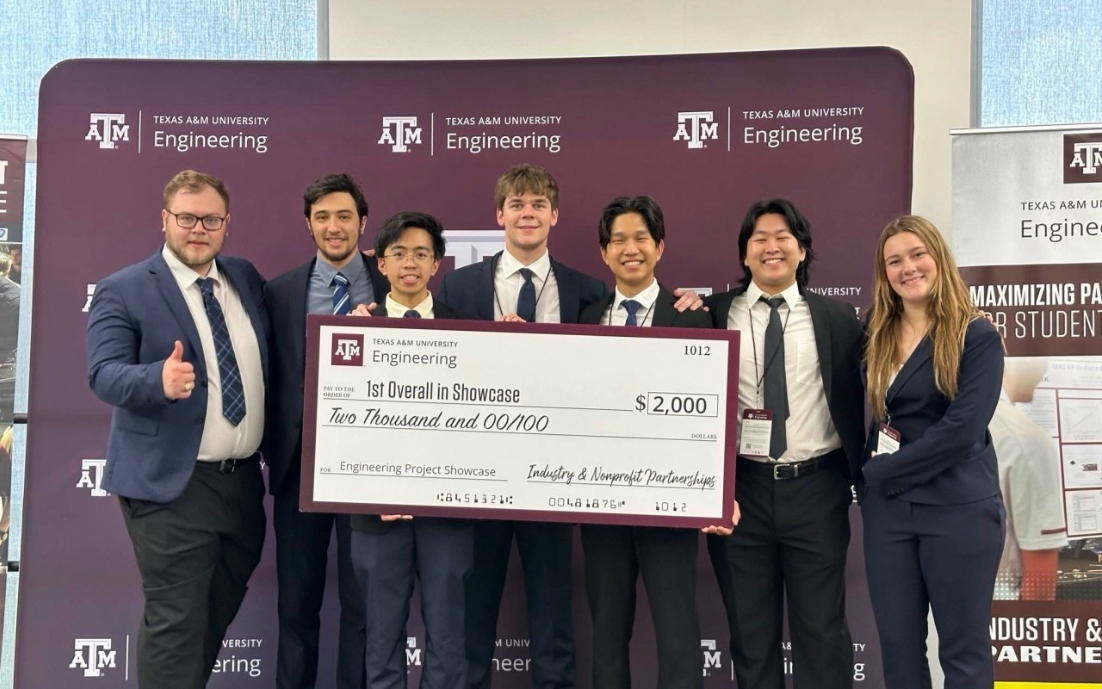
Students also refine their professional development through presentations and interactions with their industry sponsors. Awards are given for technical and overall achievements.
Why are Senior Capstone Design Courses Important?
Like the TAMU College of Engineering’s High Impact Experience requirement, it is important for Aggie chemical engineers to be capable of applied science and engineering. Senior Plant Design equips students with skills that they will need immediately after graduation, including communication, technical knowledge, and leadership. The students also use software like that used in industry, such as ASPEN, HYSYS, and more.
Senior Capstone Design Logistics
When chemical engineering students are two semesters away from graduation, they will enroll in CHEN 425, Process Integration, Simulation, and Economics. CHEN 425 is the first course in a two-course sequence focused on the synthesis, integration, simulation, and design of chemical engineering processes, introducing students to core principles of process design and economics. It covers tools for process integration, flowsheet development, equipment design, and environmentally responsible approaches, reinforced through practical problem‑solving. The lab component provides hands-on experience with computer-aided simulation of chemical‑engineering systems.
In their final semester, chemical engineering seniors enroll in CHEN 426, Plant Design. Students who complete this course will design major process equipment and determine appropriate sizes for units such as pumps, compressors, heat exchangers, and distillation columns. They will synthesize full chemical and biological processes by creating and evaluating interconnected systems of equipment to determine the most effective design. They will also develop proficiency with industry-standard computational tools, including process simulators, planning software, and graphical programs. In addition, students will learn to evaluate safety, environmental impacts, and ethical considerations using computational methods to compare design strategies. Finally, they will produce professional-quality design reports and presentations and work effectively in teams to plan, execute, and refine complex problem-solving projects.
We are always looking for new project sponsors. Please see the sponsorship section for more information.
Sponsor A CHEN 426 Project
Sponsoring a chemical engineering senior project benefits both the academic and industry sides of the partnership. The chemical engineering seniors will gain experience with solving problems in your field, and learn from your company’s unique problem statement, specifications, and dataset. Your company will have the opportunity to provide a deeper understanding of your work to a talented, hirable set of engineering seniors. You may even gain new technical insight from some of our students’ creative solutions! Our past projects have spanned the oil and gas, petrochemicals, specialty chemicals, biochemicals, and semiconductors fields.
Becoming a sponsor requires a full semester’s commitment to:
- Identify at least one engineer to represent your company throughout the project. The sponsor typically communicates with students and faculty through email, although in-person meetings may be possible.
- Provide a well-scoped chemical engineering problem statement, specifications, and data.
- Work with faculty to set up meetings and presentations with the students.
- Provide technical feedback- and encouragement- to students at mid-semester check-in meetings.
- Choose the best team projects to recognize with awards.
- Provide financial support; sponsors typically cover the expenses for plaques and prize money awarded to the top 3 best teams.
For more detailed information or to start the process of becoming a sponsor, please contact the department at chen-admin@tamu.edu.
Student Testimonial
"Senior design was the perfect capstone to my college experience. Fluid dynamic, thermodynamic, and heat transfer concepts were all pulled together, allowing our class to get to know these fundamental engineering priniciples in a new light. Under the guidance of a faculty advisor, we were able to inquire about newly understood process dynamics and receive pushback on weak assumptions. The plant design experience completely pushed the boundaries of what I thought me and my classmates were capable of as engineering seniors.
Collaboration was central to this project. Even if you gave me my entire senior year dedicated to this project, I could not have nearly designed a commercial-sized BPA plant on my own. Yet as a team of individuals with different strengths, inclinations, and academic niches, we were able combine our skills in order to build out reactors, a separation system, and even a creative energy-optimization plan that allowed us to meet product specifications and make our process profitable.
The project looks intimidating at first, but my advice is to just get into the material, expect a whole lot of wrong turns before a right one, and perhaps you too will be lost in your chemical plant design before you know it."
-Asiya Kerwin, Chemical Engineering ’24
A Word From Our Sponsors
“Working with the Texas A&M chemical engineering seniors is always a highlight for our team. Their fresh approach to real design challenges inspires us and supporting that work is one way we put our value. We innovate fearlessly into action.” -Todd Hubbard, Sr Manager Process Engineering, LUMMUS TECHNOLOGY
"Fluor is a proud sponsor of the CHEN 426 Senior Plant Design project for 20 years and counting. The projects represent real-world scenarios and allow the students to apply the entirety of their chemical engineering knowledge to solve problems and execute a project designing all types of chemical facilities. The students' growth in knowledge is noticeable throughout the semester as Fluor participates from project kickoff through drawing design reviews and final capital cost estimates. Every semester is a competition among the student teams for the best overall project that delivers a safe, reliable and affordable plant design." -Stephen Rabb, FLUOR
“We feel that the capstone project is an important experience for the student! They get exposure to a real-life problem brought by industry representatives and take a project from concept all the way through to the final approval stage. The students get valuable experience designing a process and calculating the economics of the process and gain experience in teamwork, which is important in industry.” -Dr. Steven Alferi, Distinguished Advisor R&T, Albemarle
“Texas A&M University’s senior process design course provides a competitive advantage for Aggie Chemical Engineering students. The course is an exceptional way to contribute to students’ preparation for real-world engineering practice. Students participate in competitive, team-based design projects that cultivate innovation, resilience, and accountability under realistic constraints. As one of the prior sponsors of this course, ExxonMobil sees value in students engaging directly with external industry and practicing engineers.” - Elijah Culpepper, Senior Manager, ExxonMobil, Texas A&M Chemical Engineering Graduate.