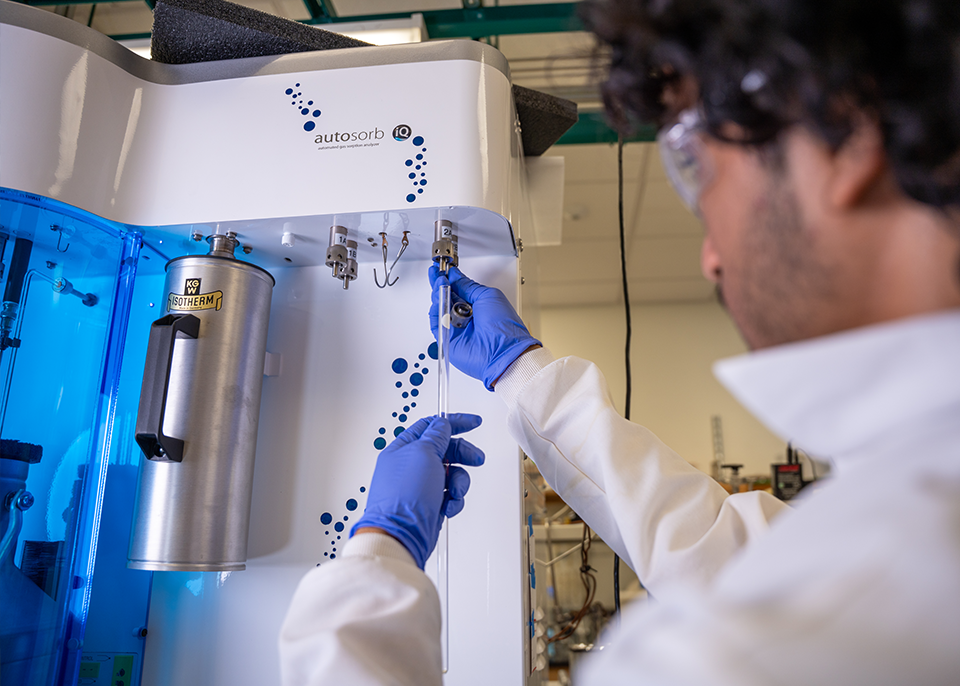
A person wearing a lab coat and gloves operates a scientific instrument, inserting a connection into the device. The instrument features blue lighting.

Chemical Engineering Research

There’s an extraordinary spirit at the heart of the Artie McFerrin Department of Chemical Engineering at Texas A&M University. Our faculty and students stand together to explore a research spectrum that spans applied innovation—like biomass utilization, process safety, and hydrocarbon processing—to transformative discoveries in nanotechnology, life sciences, and molecular simulation. United by our core values and pursuit of knowledge, we answer the call for the good of society, turning understanding into action that drives real-world impact. At the same time, we cultivate independence and leadership in our students—shaping a new generation of scientific trailblazers who will continue advancing technology for the greater good.

Research Areas

Structure–composition–property relationships in atomic-, nano-, and mesoscale materials, spanning hard, soft and 2D materials, including metals, semiconductors, ceramics, polymers and their hybrids, supported by theory and computation, multiscale simulations, industry connections, internal and external collaborations, and advanced facilities.

This field combines biological, biochemical and chemical engineering principles to investigate chemical processes in living organisms, using computational biophysics, synthetic and systems biology, and multiscale modeling to advance translational applications in health and biotechnology, supported by a critical mass of faculty and students.

Process safety focuses on understanding and preventing failures in processing systems that can lead to accidents and negative impacts. It integrates modeling, optimization, process integration, design, control, risk engineering and multiscale approaches to identify hazards, evaluate risks and improve the safety and reliability of complex systems.

This scientific discipline integrates multiple scales and system components to understand and predict physicochemical behavior through multiscale modeling, mathematical modeling, data analytics, AI/ML, process design, integration, optimization, intensification and control.

Research News