
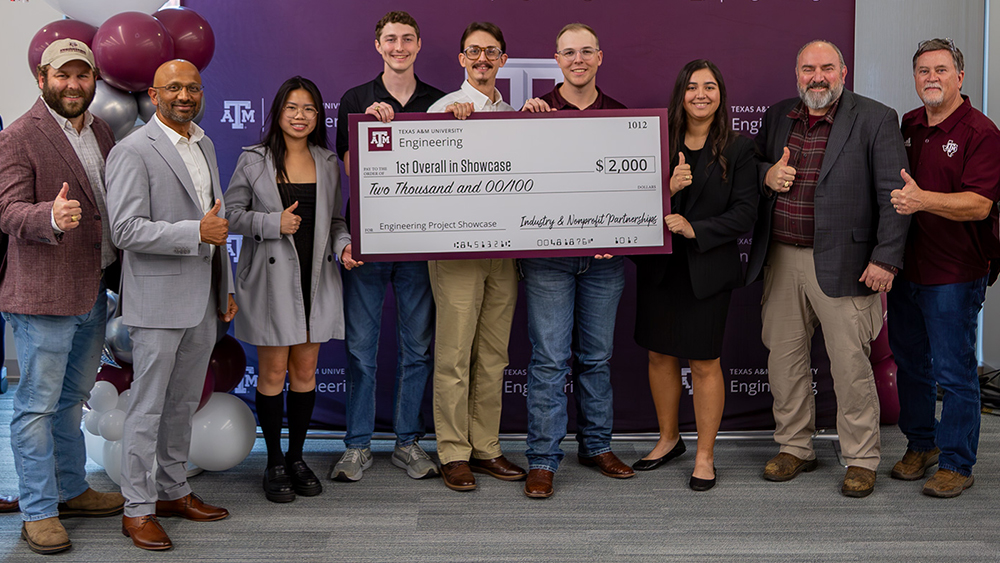
The two-semester capstone experience is the culmination of a Texas A&M engineering student’s years of education. Because hands-on, real-world learning is the cornerstone of our philosophy in the Department of Engineering Technology and Industrial Distribution, our students are well prepared to tackle the industry challenges these projects present.
Working in teams, students investigate problems, develop solutions and present their work, much as they will in their careers. The experience strengthens the technical, communication and teamwork skills needed to succeed as professionals.
The teams present their final projects in capstone showcases. Those in our engineering technology programs participate in the Texas A&M College of Engineering Project Showcase, where they are judged against teams from across the college.
Employers highly value graduates with capstone experience, recognizing their readiness to contribute immediately and lead confidently in dynamic engineering environments.
Explore Our Programs’ Capstone Experiences
Industrial Distribution (ID) capstone teams use research and systems thinking to develop solutions to distribution challenges involving areas such as logistics, operations and sales.
Electronic Systems Engineering Technology (ESET) capstone teams develop solutions using electronics, embedded systems, software and system integration.
Manufacturing and Mechanical Engineering Technology (MMET) capstone teams address manufacturing and mechanical engineering challenges through design, analysis, fabrication, testing and recommendations.
Multidisciplinary Engineering Technology (MXET) capstone teams transform engineering ideas into functional mechatronic and robotic systems by integrating mechanical design, electronics, sensors, software and control technologies.
Sponsor a Project
Have a challenge your organization would like a student team to explore? Sponsoring an ETID capstone project creates a mutually beneficial partnership. Students gain hands-on experience working with a real customer, while your organization gains cost-effective R&D and develops relationships with top-tier emerging engineers.
What Makes a Strong Project?
A capstone project should have a clear problem and room for students to investigate possible solutions. It should be substantial enough for a senior team to apply its skills, yet feasible within the two-semester academic schedule. Depending on the project, the work may involve product or system design, process improvement, logistics or operations analysis, fabrication, programming, prototyping and/or testing.
What Sponsors Provide
- Project idea: Describe the problem, why it matters and the outcome you hope to achieve. You do not need to arrive with a finished project plan.
- Point of contact: Identify someone who can explain the challenge, answer questions and give the team feedback throughout the project.
- Project resources: Discuss anticipated materials, equipment, data, access and funding with the program before the project begins. Support needs depend on the scope.
How to Get Started
- 1. Reach out to the applicable program: See contacts below.
- 2. Share your idea: Send a description of the challenge, desired outcome and any timing or resource needs.
- 3. Project Analysis: Faculty and sponsors work together to determine whether a proposal fits a program’s learning goals and available time. If your project involves confidential information or intellectual property, raise that during the initial discussion so the appropriate university process can be addressed before work begins.
Contacts by Program
Daniel Rey
- Associate Professor of Practice, Engineering Technology & Industrial Distribution
- Industrial Distribution
- Office: FERM 203B
- Phone: 979-845-3148
- Email: daniel.rey@tamu.edu

Rainer Fink
- Program Coordinator, Electronic Systems Engineering Technology
- Professor, Engineering Technology & Industrial Distribution
- Electronic Systems Engineering Technology
- Office: FERM 111A
- Phone: 979-845-5150
- Email: fink@tamu.edu

Darrin Willauer
- Senior Lecturer, Engineering Technology & Industrial Distribution
- Manufacturing & Mechanical Engineering Technology
- Office: THOM 118J
- Phone: 979-845-2361
- Email: dlwillauer@tamu.edu

Kiju Lee
- Program Coordinator, Multidisciplinary Engineering Technology
- Associate Professor, Engineering Technology & Industrial Distribution and Mechanical Engineering
- Multidisciplinary Engineering Technology
- Office: SBSA 118G, MEOB 219
- Phone: 979-458-6479
- Email: kiju.lee@tamu.edu
