
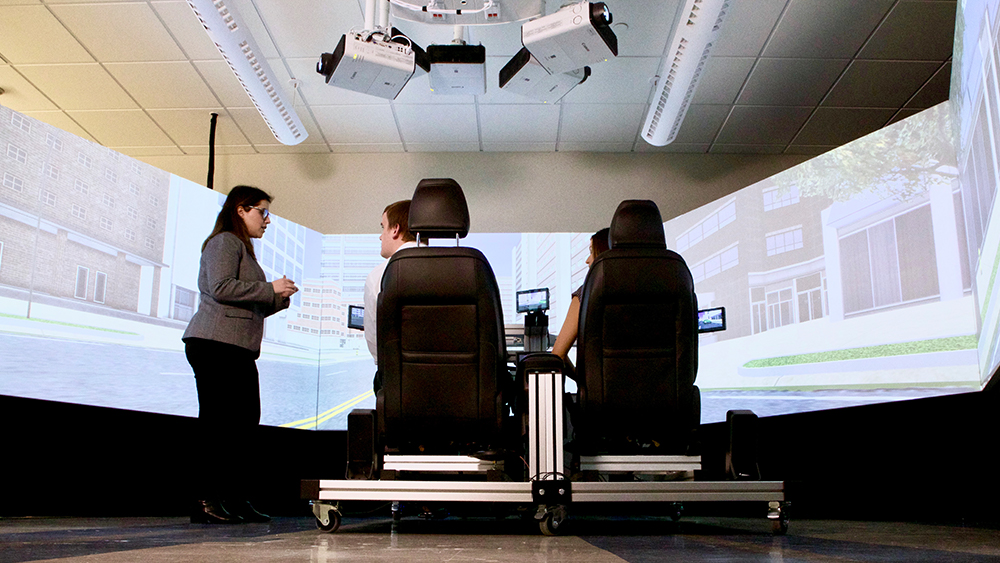
ISEN houses one of the nation’s largest and most diverse Human Factors and Ergonomics programs, featuring an HFES Fellow, five HFES and IISE early-career awardees, journal Editors-in-Chief, and highly cited faculty—reflected in world-class facilities, robust industry engagement, a vast alumni network, and a track record of nurturing 14 academic placements in the last decade, two Human Factors Prizes, and over 10 national graduate student awards.
Health and Human Systems Engineering examines human capabilities, limitations, and performance in complex sociotechnical systems, from hospitals and clinics to spaceflight, transportation, manufacturing, and emergency response.
Faculty combine biomechanics, cognitive engineering, human-centered design, computational modeling, and data-driven analytics to understand and improve how people and technology work together.
This work delivers safer human–technology interaction, lower injury risk, better operational decision-making, and measurable performance gains across healthcare and other high-reliability settings.
Physical Ergonomics and Occupational Biomechanics
Evaluates human physical capabilities, environmental stressors, and physical workloads to reduce musculoskeletal injury risk, assess gait and fatigue, and advance fall prevention for aging populations.Work Design, Measurement, and Safety
Applies work domain and task analysis, time-and-motion study, and sociotechnical macroergonomics to assess hazards, strengthen occupational and process safety, and structure high-performing teams.Cognitive Ergonomics and Neuroergonomics
Studies cognitive workload, stress, attention and interruption management, and neural and physiological markers of operator state to inform interface design, usability testing, performance modeling, and adaptive training.Human–AI Teaming and Autonomous Systems
Investigates human–automation interaction, robotic collaboration, and adaptive autonomy to establish trust, transparency, and explainability in decision support and joint human–AI operation.Health Systems Engineering and Care Delivery
Models, simulates, and optimizes care delivery, access, and clinical workflow—spanning patient safety, telehealth and remote monitoring, and preventive and population health.Human Systems Integration for High-Consequence Operations
Advances human systems integration, safety and mission assurance, and systems engineering for spaceflight, aviation, transportation, and emergency response.
